HCLTech’s October 12 results show a business finding new demand in artificial intelligence while its much larger revenue base grows modestly. Advanced AI revenue rose 78% year on year in constant currency to $219 million. Company-wide revenue grew 2.6% on the same currency-adjusted basis.
The investment question is how much of the new activity becomes durable cash earnings for shareholders. This quarter offers encouraging evidence on margins and bookings, alongside reasons to keep testing productivity and cash conversion. A premium valuation would require sustained improvement beyond the fastest-growing revenue category.
This memo covers the quarter ended September 30, 2026, or Q2 FY27. Figures come from HCLTech’s October 12 investor release.
Start with the economic engine
HCLTech operates three related businesses. IT and Business Services accounted for 75.4% of quarterly revenue; Engineering and R&D Services contributed 16.7%; HCLSoftware supplied 7.9%. Their year-on-year constant-currency growth rates were 4.4%, 2.1% and minus 11.2%, respectively. The portfolio therefore contains several different demand and pricing cycles.
Enterprise clients pay HCLTech to build, modernise and operate technology. Its economic advantages can include accumulated knowledge of a customer’s systems, delivery capabilities and the inconvenience of replacing an embedded supplier. Those advantages must continually earn their keep through service quality and competitive pricing.
AI can strengthen that relationship by making HCLTech useful for new projects. It can also reduce the labour required for existing work. Whether shareholders benefit depends on contract terms, customer bargaining power and the new work created by lower delivery costs.
A fast-growing category still needs a company-wide test
Advanced AI’s $219 million represented approximately 5.9% of the quarter’s $3,724 million revenue, calculated by dividing the two reported dollar figures. That is a scale comparison, not a standalone segment valuation. The release does not provide a separate Advanced AI profit or cash-flow statement.
Two hypotheses remain plausible. AI may accelerate demand as customers commission infrastructure, integration and new applications. Alternatively, some new AI spending may replace existing services spending while automation reduces billable effort. Both effects could occur at the same client.
Revenue per employee offers one check. HCLTech reported $65,400 annually, up 2.4% year on year and down 0.1% sequentially. This is a trailing measure: the company divides the last twelve months’ revenue by average quarter-end headcount across five quarters. It cannot immediately capture a productivity breakthrough in the latest quarter. Currency, acquisitions, staffing changes, utilisation and business mix can also affect it. Nor does it include subcontractor headcount in the denominator.
The appropriate conclusion is that a broad productivity acceleration remains to be demonstrated. Investors should also require stable AI-category definitions and comparable historical data. Expanding what is counted as AI could alter a growth comparison without an equivalent change in the underlying business; this memo does not assert that such a change occurred this quarter.
Margins improved, but adjustment discipline matters
Reported EBIT margin reached 18.2%, despite an 84-basis-point restructuring impact. Adding that impact back mechanically gives approximately 19.0%, based on the rounded headline margin. This calculation is useful for understanding the charge’s size, but it is not automatically sustainable earnings power.
The release identifies restructuring impacts in each of the preceding four quarters too. Investors should ask what work remains, what savings have been realised and when related cash payments occur. Repeated recent charges deserve scrutiny; they do not prove that these costs continue permanently.
There is also a favourable tax contribution to the earnings result. Rupee EBIT increased from ₹5,550 crore a year earlier to ₹6,465 crore, approximately 16.5%. Net income rose faster, by 21.2% to ₹5,132 crore, while the tax provision fell from ₹1,466 crore to ₹1,335 crore. Forecasting net-income growth straight from this quarter would therefore be aggressive without understanding the sustainable tax rate.
Management’s FY27 guidance is 2.5%–4.0% constant-currency company revenue growth and a 17.5%–18.5% EBIT margin. That is the relevant near-term anchor when assessing how quickly AI changes the consolidated economics.
Cash conversion and acquisition spending
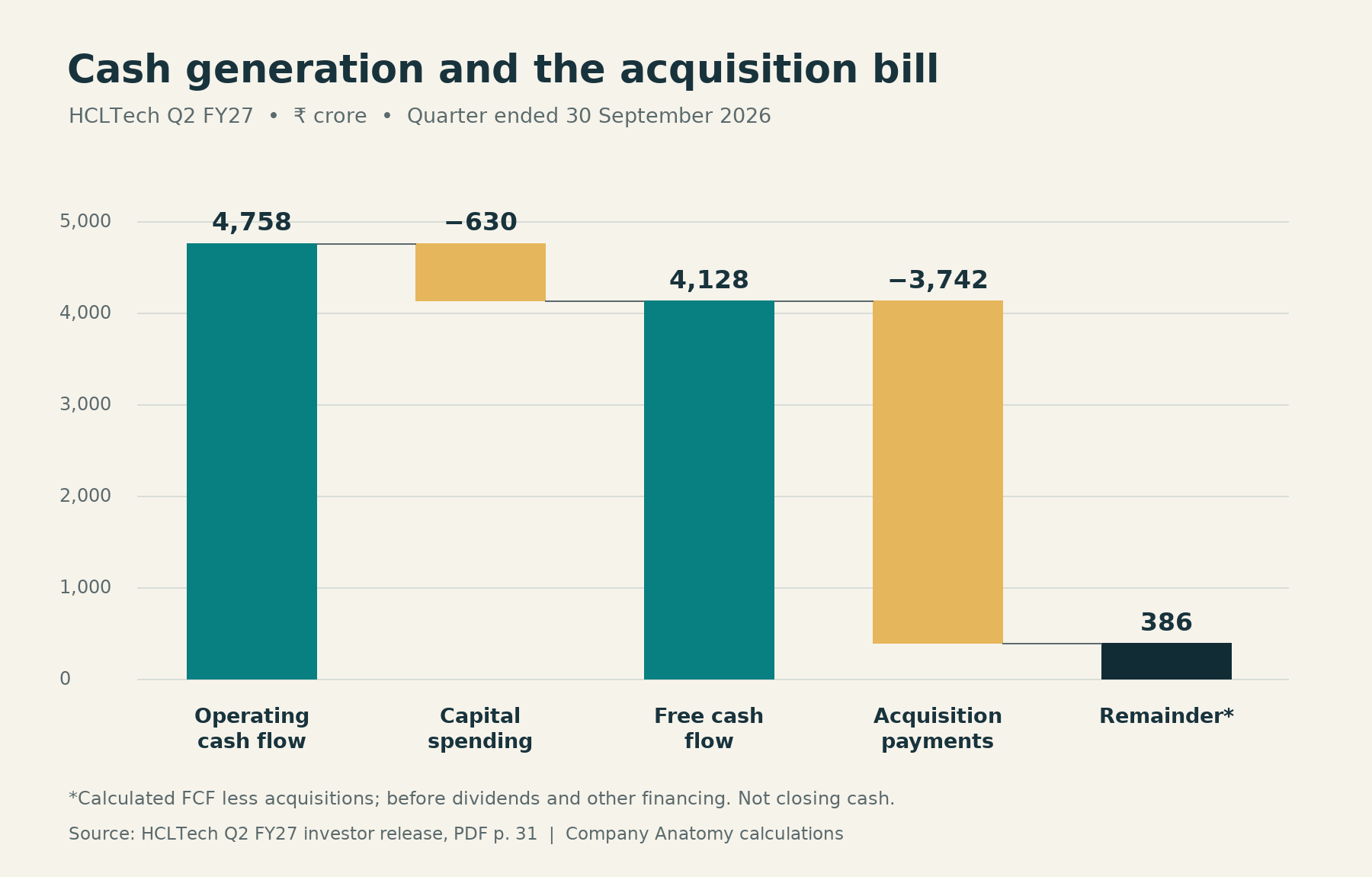
Quarterly operating cash flow was ₹4,758 crore. After ₹630 crore of purchases of property, equipment and intangibles, company-defined free cash flow was ₹4,128 crore: approximately 80.4% of quarterly net income.
The trailing-twelve-month free-cash-flow/net-income ratio was 87% on the release’s highlighted basis. Its footnote gives 90% when the one-time New Labour Codes impact is included in net income. The change is a denominator effect, not extra cash generated. Investors should preserve this distinction when comparing periods.
Acquisitions matter too. Payments of ₹3,742 crore sit outside the quarter’s free-cash-flow subtotal. Subtracting them leaves ₹386 crore before dividends and other financing. These purchases may build valuable capabilities; charging every acquisition against recurring earnings would be crude. Ignoring the capital deployed would be equally unhelpful. Subsequent revenue, cash returns and integration costs must justify it.
Company-defined net cash was ₹24,503 crore at September 30. That calculation deducts borrowings from gross cash but does not deduct lease liabilities. It offers financial flexibility, subject to the cash needed to operate the business and fund commitments.
What would justify paying more?
HCLTech reported 41.2% trailing return on invested capital and $3,258 million of new-deal total contract value. These support the constructive case: a profitable incumbent is winning work while developing new capabilities. Contract value is not revenue already earned, however. Conversion timing, delivery costs and profitability determine its eventual value.
Valuation should start with normalised operating cash flow, capital spending, working-capital requirements and a realistic allowance for reinvestment. A downside case would combine weak revenue growth, customer capture of AI savings and continuing transition costs. A central case would reflect modest growth and margins consistent with guidance. An upside case would require sustained new demand and productivity gains that HCLTech retains economically.
One accounting trap deserves explicit attention: the release’s ₹70.22 diluted EPS is for the last twelve months, not this quarter, and excludes the New Labour Codes impact. Including that impact, it is ₹67.56. Neither figure should be multiplied by four. Any earnings multiple must identify which denominator it uses.
No current share-price valuation or target price is asserted here. Without a verified purchase price and explicit cash-flow assumptions, a claim that the shares are cheap would be unsupported. This follows Company Anatomy’s business-first research methodology.
Evidence that would change the view
The strongest countercase to caution is that revenue per employee is a lagging indicator and new bookings take time to become revenue. Today’s investment could precede materially stronger cash generation.
That case would strengthen if comparable AI revenue growth accompanies faster consolidated growth, improving productivity, sound cash conversion and returns from acquisitions. Concern would increase if AI growth remains rapid while company-wide growth stalls, customers retain most efficiency savings or repeated adjustments obscure the cash cost of delivery.
The quarter shows progress. The next test is whether that progress compounds into cash earnings per share at an attractive price.
Primary sources
- HCLTech Q2 FY27 investor release and exchange covering letter
- Condensed consolidated IFRS statements for the three and six months ended September 30, 2026
Disclosure: The author confirms that he, his associates and relatives have no holdings in HCLTech and no compensation or dealings with the company.
Regulatory information
This page provides general information about Company Anatomy and the disclosure principles applied to its research. Every dated research report must also be read with its own disclosures, assumptions, risks and source notes.
Research Analyst information
| Name | Aditya Siddharth Mehta |
|---|---|
| Capacity | SEBI-registered Research Analyst — individual registration |
| SEBI registration number | INH000029768 |
| SEBI validity from | 20 August 2026 — Perpetual |
| BSE enlistment number | 7462 |
| Business name | Company Anatomy |
| Telephone | +91 7021135925 |
| Email and grievance contact | adi2001me@gmail.com |
| Correspondence address | Aditya Villa, Daksha Niwas, S.T. Road, Chembur, Mumbai, Maharashtra 400071 |
Business activities and service scope
Company Anatomy publishes independent equity research and educational material concerning Indian listed companies. Research may include business analysis, financial estimates, valuation work, risks and analyst judgement. The website does not provide portfolio management, trade execution, custody, banking, legal, tax or personalised financial-planning services.
Independent and completely free public research
All Company Anatomy research and reports are independent and completely free to read and download. There is no subscription charge, purchase condition or obligation to open a brokerage account or trade. Free public access is a core value of Company Anatomy. Research opinions are intended to reflect analysis and evidence rather than a reader’s transactions.
Merely reading or downloading publicly available research does not by itself create a personalised investment-advisory engagement or an agreement for a separately arranged service. It does not waive investor protections or remove applicable Research Analyst obligations. Whether a particular relationship constitutes a client relationship depends on the actual arrangements and applicable law, including direct or indirect economic benefits; it cannot be settled by calling a report “free”.
Reports are not an offer, invitation or solicitation to buy or sell any security or to enter into a transaction. Where a report contains a recommendation, rating or target price, it remains research subject to applicable requirements; it is not personalised investment advice. Do not use a report as the sole basis for an investment decision.
General nature of research
Research and recommendations are general and are not tailored to an individual reader’s objectives, financial situation, risk tolerance or needs. General website information is not a personalised investment recommendation or a solicitation of an offer to buy or sell a security. This distinction does not exclude the Research Analyst’s applicable regulatory duties. Investors should make an independent assessment and obtain professional advice appropriate to their circumstances.
Sources, estimates and changes
Information is obtained from sources believed to be reliable, with preference for company filings, exchange disclosures and other primary material. Accuracy, adequacy and completeness are not guaranteed. Information may be incomplete or condensed. Forecasts, valuations, target prices and scenarios are estimates rather than facts. Opinions and estimates are the Research Analyst’s judgement as of the stated date and may change without notice.
Ownership, financial interests and material conflicts
Each research report or public recommendation must state, as applicable, whether the Research Analyst, associates or relatives have a financial interest in the subject company; actual or beneficial ownership of one per cent or more of its securities at the end of the month immediately preceding publication; or another material conflict of interest. Aditya Siddharth Mehta has confirmed that there is no business conflict of interest as of 17 September 2026. This business-conflict declaration is not a declaration that the analyst, associates or relatives have no security holdings or issuer relationships. Because holdings and circumstances can change, this general page does not make a permanent “no conflict” representation. The dated report-specific disclosure governs.
Compensation and other relationships
Each research report must disclose applicable compensation received from the subject company during the preceding twelve months, including compensation for investment-banking, merchant-banking, brokerage or other products and services; compensation or benefits connected with the research; whether the subject company was a client during the applicable period; and participation in managing or co-managing a public offering. No blanket statement is made on this page because the disclosure must be current for the subject company and report date.
Other report-specific declarations
- Whether the Research Analyst serves as an officer, director or employee of the subject company.
- Whether the Research Analyst has engaged in market-making activity in the subject company’s securities.
- Relevant associates, business relationships and any fact that could affect independence or objectivity.
- The valuation method and material risks that may prevent achievement of a stated target price.
- Any material disciplinary history, regulatory action, litigation, inspection or investigation required to be disclosed.
If a required report-specific declaration is absent or unclear, do not rely on the recommendation until clarification is obtained from the Research Analyst.
Use of artificial intelligence
Company Anatomy uses artificial intelligence to improve readability and writing, assist valuation calculations and run simulations. The extent and material role of AI in a particular report should be read with that report’s methods and source notes. The Research Analyst remains responsible for the research, human review, accuracy controls, security, confidentiality, integrity and regulatory compliance, regardless of the extent of AI use. AI can produce incorrect text, calculations or assumptions. Readers should cross-check material figures against original filings and source documents, examine assumptions and periodically consult a SEBI-registered investment adviser about their own financial circumstances. These precautions do not transfer the analyst’s regulatory responsibilities to the reader.
Valuation, forecasts and simulation limitations
Valuation models and simulations are conditional analytical tools. Outputs depend on input quality, assumptions, correlations, distributions and model design; they can omit risks and produce materially different results when assumptions change. A simulated frequency is not an observed probability of future investment success. Model values and target prices are not guarantees, promises of returns or precise forecasts. Review the valuation date, horizon, scenarios, sensitivity analysis and downside risks. Historical or simulated performance does not establish future performance.
Market risk and performance
Investment in securities market are subject to market risks. Read all the related documents carefully before investing.
Past performance is not an indicator of future performance. Prices and returns may be volatile, and an investor may lose part or all of the capital invested. Registration granted by SEBI, enlistment with BSE and certification from NISM in no way guarantee performance of the intermediary or provide any assurance of returns to investors.
Distribution, report versions and corrections
Research is intended for lawful access and use. It is not directed to a person or jurisdiction where distribution or use would breach applicable law or require a registration that the Research Analyst does not hold. Free access is not a representation of authorisation outside India. When sharing a report link, retain its date, author, qualifications and disclosures; do not present extracts or simulations as guaranteed returns. A downloaded copy reflects its stated publication date. Check the original report page for subsequent revisions and contact the Research Analyst about a suspected error.
Website, third-party links and liability
The website and its content are provided for information on an “as is” and “as available” basis. Links to third-party websites are provided for convenience and do not constitute endorsement. To the extent permitted by applicable law, Company Anatomy is not responsible for decisions made solely in reliance on general website content or for loss arising from third-party content, interruptions or technical errors. Nothing on this page excludes duties or liability that cannot lawfully be excluded.
Grievances and dispute resolution
First raise a concern directly with Company Anatomy using adi2001me@gmail.com. If the response is unsatisfactory, use SEBI SCORES. Eligible unresolved disputes may be taken to SMART ODR in accordance with the applicable process. See the Grievance Redressal, Investor Charter and Investor Complaints pages.
Regulatory sources
- SEBI Master Circular for Research Analysts, 6 February 2026
- SEBI Investor Charter for Research Analysts, 2 June 2025
Last reviewed: 17 September 2026. This page should be updated when the applicable regulatory framework or the Research Analyst’s material circumstances change.