Research cutoff: 4 October 2026, 12:15 UTC / 17:45 IST.
Bajaj Finance’s latest disclosures put two questions together. Its loan book is expanding rapidly. It also wants more equity capital. For an existing shareholder, the useful question is how much additional value each existing share can receive after paying for that growth.
FACT: On 1 October, the board approved proposals for up to ₹11,700 crore through a qualified institutions placement and up to ₹5,800 crore through convertible warrants to Bajaj Finserv. Shareholder and other applicable approvals remain necessary; issue prices have not been fixed. [1]
FACT: The 3 October provisional update reported consolidated assets under management of approximately ₹584,750 crore at September-end, up 26.5% year on year. New loans booked rose 11% to 13.45 million. The company cautioned that the earlier festive season last year affects the volume comparison. The update is subject to statutory-auditor review. It contains no September-quarter profit, credit-cost or capital-adequacy figure. [2]
ANALYST JUDGEMENT: The financing structure deserves more attention than the headline amount. Three tests matter: when the cash arrives, what the new shares cost existing owners, and what the additional equity earns after losses.
The cash arrives in stages
FACT: The warrant terms require at least 25% of consideration on allotment, with the remaining 75% payable on conversion. The exercise window is eighteen months from allotment, or another period permitted under the applicable regulations. Failure to exercise entails forfeiture under the disclosed terms. [1]
ESTIMATE: If both proposals reach their maximum sizes, the QIP is fully funded and only the minimum warrant instalment is paid, the initial gross proceeds would be ₹13,150 crore: ₹11,700 crore plus ₹1,450 crore. A further ₹4,350 crore would depend on exercise and payment. Expenses would reduce net proceeds. This is a conditional funding illustration, not cash already received or a forecast of timing.
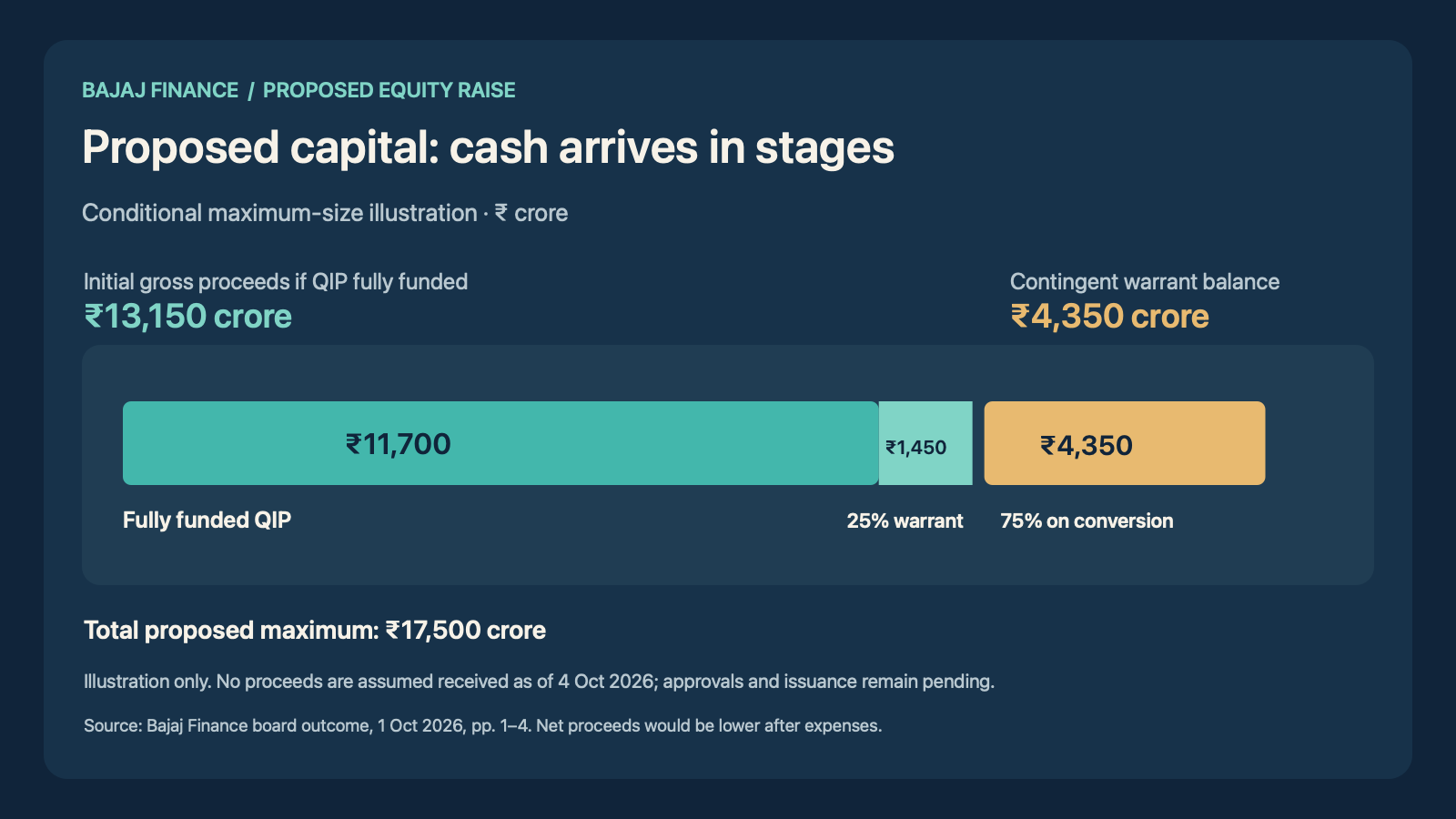
That distinction matters for capital deployment. A plan using the entire ₹17,500 crore from day one assumes more than the initial payment terms require. Conversely, an early warrant conversion could bring the balance in sooner. Neither the shortest nor the longest possible delay belongs in a base case without evidence.
The warrant commitment has an economic cost to the parent because its initial payment is at risk. Calling this a free option would be inaccurate.
Promoter participation and ownership preservation
FACT: Bajaj Finserv disclosed a 51.30% holding and said its participation is intended to demonstrate support and confidence to prospective investors. It also distinguished that intention from Bajaj Finance’s immediate capital needs. [3]
ESTIMATE: At the maximum proposed amounts, the parent would supply 33.14% of total new money, calculated as ₹5,800 crore divided by ₹17,500 crore. If both instruments ultimately issue shares at the same price, that would also represent 33.14% of the newly issued shares. A shareholder starting at 51.30% would therefore see its ownership percentage fall under those assumptions, despite investing more money.
The eventual percentage depends on separate issue prices, actual sizes, conversion and other share issuance. The point is narrower: participation alone cannot establish that the parent’s percentage is preserved. A post-issue shareholding table is the evidence to wait for.
What dilution actually means
Selling new shares reduces a non-participating owner’s percentage of the business. Whether it reduces that owner’s economic value depends on the price received and what the business does with the proceeds.
ESTIMATE: A deliberately hypothetical example makes this distinction clear. Imagine a lender with 100 shares, ₹10,000 of equity and ₹2,000 of annual earnings. Book value is ₹100 per share and earnings are ₹20 per share. It issues ten shares at ₹200 each, raising ₹2,000. Before costs, book value rises to ₹109.09 per share. If profits initially remain unchanged, earnings fall to ₹18.18 per share.
Book value has increased while earnings per share have decreased. If that new equity subsequently earns ₹400 annually after tax and credit losses, total earnings become ₹2,400 and earnings per share rise to ₹21.82. The economics, rather than the share count alone, decide the result. These figures are an educational illustration, not Bajaj Finance’s balance sheet, issue price or earnings forecast.
Cash generation for a lender
A lender requires a different owner-cash lens from a manufacturer. Loan disbursements consume cash, while collections, deposits and borrowings replenish it. A negative operating-cash-flow number during loan-book growth does not by itself establish poor business quality. Equally, borrowing more money is not shareholder profit.
The central question is how much earnings can eventually be distributed after replacing credit losses and retaining the equity needed to support prudent growth. An equity raise can strengthen that capacity. It can also mask weak economics if the institution repeatedly needs fresh capital without delivering adequate returns on the enlarged base.
FACT: The July presentation reported consolidated annualised return on equity of 20.4% for Q1 FY27, against 18.1% for FY26. The reported standalone capital-adequacy ratio was 20.90% at June-end, with Tier 1 at 20.01%. These are historical observations, not September readings or post-raise estimates. [4]
A useful valuation discipline
ESTIMATE: On a fully funded ₹17,500 crore increment, sustained annual after-tax returns of 10%, 15% and 20% would correspond to ₹1,750 crore, ₹2,625 crore and ₹3,500 crore of additional annual profit. These are sensitivities, not guidance. They assume the full amount remains productively deployed and ignore transition timing. Leverage, funding costs, operating costs and credit losses must already be reflected in the chosen return.
The gap between these outcomes is why a large raise cannot automatically justify a higher valuation. Paying a premium for a lender assumes that attractive returns persist despite competition, larger scale and future credit cycles. A higher book value offers limited protection if underwriting deteriorates or the market stops paying the same premium for each rupee of book.
This memo does not establish fair value or a margin of safety at the current share price. Issue prices and the eventual capital deployment remain unknown. A defensible valuation would combine the final share count with normalised returns, retained-capital requirements and a downside credit scenario, rather than capitalise one strong quarter indefinitely.
The strongest countercase
ANALYST JUDGEMENT: Raising equity before it becomes urgently necessary can be sensible. It may preserve lending flexibility and reduce the chance of an expensive emergency raise during a downturn. A temporary decline in reported return on equity can be an acceptable price for resilience if later deployment earns an adequate return.
The adverse case is growth that looks attractive in AUM but requires persistent new equity, weaker underwriting or lower returns. September’s operating update cannot yet distinguish those outcomes. Nor should a decline in capital adequacy caused by healthy growth be confused automatically with credit distress.
What would change the assessment
The next evidence should answer specific questions:
- Do the EGM documents and final issue terms identify credible uses, pricing and post-issue ownership?
- How much cash is actually received, and when is the warrant balance paid?
- Do subsequent results show acceptable credit losses and funding economics alongside growth?
- Does additional capital produce durable earnings per share and distributable capacity after allowing a reasonable deployment period?
The financing case strengthens if those results show productive deployment without deterioration in underwriting. It weakens if capital is absorbed while losses rise and per-share earning power fails to improve. The relevant unit of progress is the existing shareholder’s long-term economic claim.
Sources
[1] Bajaj Finance, board outcome, 1 October 2026, pp. 1–4.
[2] Bajaj Finance, provisional Q2 FY27 business update, 3 October 2026, p. 1.
[3] Bajaj Finserv, warrant subscription disclosure, 1 October 2026, pp. 1–3.
[4] Bajaj Finance, Q1 FY27 investor presentation, 30 July 2026, pp. 8, 27, 37, 42. Capital-adequacy basis is explicitly standalone on p. 42.
Related reading
Company Anatomy research methodology explains the approach to business quality, cash generation and valuation. For another capital allocation case, read the ITC Yoga Bar buyout viewpoint.
Disclosures and risk
As confirmed on 4 October 2026, the research analyst has no holdings in Bajaj Finance or Bajaj Finserv; to the best of his knowledge, neither do his associates or relatives, including derivatives or ownership of 1% or more as of 30 September 2026. The analyst confirmed no compensation, business relationship, company role, market-making activity or other material conflict involving either company for himself or his associates in the preceding 12 months.
This is general research and information, not a personalised recommendation or a solicitation to buy or sell securities. Figures marked ESTIMATE are scenarios or calculations, not company guidance. Facts reflect cited disclosures at the research cutoff and may change. Investment in securities markets involves risk; past performance and hypothetical outcomes do not assure future returns. Read the full disclosures and disclaimers. Artificial intelligence assisted with writing, calculations and the chart; AI outputs can contain errors, so readers should check material figures against the original sources.
Regulatory information
This page provides general information about Company Anatomy and the disclosure principles applied to its research. Every dated research report must also be read with its own disclosures, assumptions, risks and source notes.
Research Analyst information
| Name | Aditya Siddharth Mehta |
|---|---|
| Capacity | SEBI-registered Research Analyst — individual registration |
| SEBI registration number | INH000029768 |
| SEBI validity from | 20 August 2026 — Perpetual |
| BSE enlistment number | 7462 |
| Business name | Company Anatomy |
| Telephone | +91 7021135925 |
| Email and grievance contact | adi2001me@gmail.com |
| Correspondence address | Aditya Villa, Daksha Niwas, S.T. Road, Chembur, Mumbai, Maharashtra 400071 |
Business activities and service scope
Company Anatomy publishes independent equity research and educational material concerning Indian listed companies. Research may include business analysis, financial estimates, valuation work, risks and analyst judgement. The website does not provide portfolio management, trade execution, custody, banking, legal, tax or personalised financial-planning services.
Independent and completely free public research
All Company Anatomy research and reports are independent and completely free to read and download. There is no subscription charge, purchase condition or obligation to open a brokerage account or trade. Free public access is a core value of Company Anatomy. Research opinions are intended to reflect analysis and evidence rather than a reader’s transactions.
Merely reading or downloading publicly available research does not by itself create a personalised investment-advisory engagement or an agreement for a separately arranged service. It does not waive investor protections or remove applicable Research Analyst obligations. Whether a particular relationship constitutes a client relationship depends on the actual arrangements and applicable law, including direct or indirect economic benefits; it cannot be settled by calling a report “free”.
Reports are not an offer, invitation or solicitation to buy or sell any security or to enter into a transaction. Where a report contains a recommendation, rating or target price, it remains research subject to applicable requirements; it is not personalised investment advice. Do not use a report as the sole basis for an investment decision.
General nature of research
Research and recommendations are general and are not tailored to an individual reader’s objectives, financial situation, risk tolerance or needs. General website information is not a personalised investment recommendation or a solicitation of an offer to buy or sell a security. This distinction does not exclude the Research Analyst’s applicable regulatory duties. Investors should make an independent assessment and obtain professional advice appropriate to their circumstances.
Sources, estimates and changes
Information is obtained from sources believed to be reliable, with preference for company filings, exchange disclosures and other primary material. Accuracy, adequacy and completeness are not guaranteed. Information may be incomplete or condensed. Forecasts, valuations, target prices and scenarios are estimates rather than facts. Opinions and estimates are the Research Analyst’s judgement as of the stated date and may change without notice.
Ownership, financial interests and material conflicts
Each research report or public recommendation must state, as applicable, whether the Research Analyst, associates or relatives have a financial interest in the subject company; actual or beneficial ownership of one per cent or more of its securities at the end of the month immediately preceding publication; or another material conflict of interest. Aditya Siddharth Mehta has confirmed that there is no business conflict of interest as of 17 September 2026. This business-conflict declaration is not a declaration that the analyst, associates or relatives have no security holdings or issuer relationships. Because holdings and circumstances can change, this general page does not make a permanent “no conflict” representation. The dated report-specific disclosure governs.
Compensation and other relationships
Each research report must disclose applicable compensation received from the subject company during the preceding twelve months, including compensation for investment-banking, merchant-banking, brokerage or other products and services; compensation or benefits connected with the research; whether the subject company was a client during the applicable period; and participation in managing or co-managing a public offering. No blanket statement is made on this page because the disclosure must be current for the subject company and report date.
Other report-specific declarations
- Whether the Research Analyst serves as an officer, director or employee of the subject company.
- Whether the Research Analyst has engaged in market-making activity in the subject company’s securities.
- Relevant associates, business relationships and any fact that could affect independence or objectivity.
- The valuation method and material risks that may prevent achievement of a stated target price.
- Any material disciplinary history, regulatory action, litigation, inspection or investigation required to be disclosed.
If a required report-specific declaration is absent or unclear, do not rely on the recommendation until clarification is obtained from the Research Analyst.
Use of artificial intelligence
Company Anatomy uses artificial intelligence to improve readability and writing, assist valuation calculations and run simulations. The extent and material role of AI in a particular report should be read with that report’s methods and source notes. The Research Analyst remains responsible for the research, human review, accuracy controls, security, confidentiality, integrity and regulatory compliance, regardless of the extent of AI use. AI can produce incorrect text, calculations or assumptions. Readers should cross-check material figures against original filings and source documents, examine assumptions and periodically consult a SEBI-registered investment adviser about their own financial circumstances. These precautions do not transfer the analyst’s regulatory responsibilities to the reader.
Valuation, forecasts and simulation limitations
Valuation models and simulations are conditional analytical tools. Outputs depend on input quality, assumptions, correlations, distributions and model design; they can omit risks and produce materially different results when assumptions change. A simulated frequency is not an observed probability of future investment success. Model values and target prices are not guarantees, promises of returns or precise forecasts. Review the valuation date, horizon, scenarios, sensitivity analysis and downside risks. Historical or simulated performance does not establish future performance.
Market risk and performance
Investment in securities market are subject to market risks. Read all the related documents carefully before investing.
Past performance is not an indicator of future performance. Prices and returns may be volatile, and an investor may lose part or all of the capital invested. Registration granted by SEBI, enlistment with BSE and certification from NISM in no way guarantee performance of the intermediary or provide any assurance of returns to investors.
Distribution, report versions and corrections
Research is intended for lawful access and use. It is not directed to a person or jurisdiction where distribution or use would breach applicable law or require a registration that the Research Analyst does not hold. Free access is not a representation of authorisation outside India. When sharing a report link, retain its date, author, qualifications and disclosures; do not present extracts or simulations as guaranteed returns. A downloaded copy reflects its stated publication date. Check the original report page for subsequent revisions and contact the Research Analyst about a suspected error.
Website, third-party links and liability
The website and its content are provided for information on an “as is” and “as available” basis. Links to third-party websites are provided for convenience and do not constitute endorsement. To the extent permitted by applicable law, Company Anatomy is not responsible for decisions made solely in reliance on general website content or for loss arising from third-party content, interruptions or technical errors. Nothing on this page excludes duties or liability that cannot lawfully be excluded.
Grievances and dispute resolution
First raise a concern directly with Company Anatomy using adi2001me@gmail.com. If the response is unsatisfactory, use SEBI SCORES. Eligible unresolved disputes may be taken to SMART ODR in accordance with the applicable process. See the Grievance Redressal, Investor Charter and Investor Complaints pages.
Regulatory sources
- SEBI Master Circular for Research Analysts, 6 February 2026
- SEBI Investor Charter for Research Analysts, 2 June 2025
Last reviewed: 17 September 2026. This page should be updated when the applicable regulatory framework or the Research Analyst’s material circumstances change.