ITC completed its purchase of Yoga Bar’s parent, Sproutlife Foods, on 28 September 2026. The final cheque was about ₹645 crore for the remaining 52.5% interest. For a long-term shareholder, the question is whether the additional share of future earnings and cash will justify that price. Full ownership gives ITC more of the economic outcome, including any future losses. ITC’s completion filing
Our judgement is that this is a useful test of ITC’s acquisition discipline. The transaction has a credible strategic rationale and a growing business behind it. Evidence of an attractive investment return will require more than a rising sales figure or an accounting gain.
Three amounts that answer different questions
FACT: ITC’s initial investment of ₹175 crore bought 39.42% in May 2023. Subsequent investments brought cumulative deployment to approximately ₹255 crore and ownership to 47.5% by September 2024. Adding the latest payment gives approximately ₹900 crore across the acquisition’s stages. Initial completion · September 2024 filing
CALCULATION: ₹645 crore divided by 52.5% implies approximately ₹1,229 crore for all the equity at the final tranche’s price. Against Sproutlife’s reported FY2026 turnover of ₹452 crore, that is about 2.72 times sales. The cumulative ₹900 crore equals about 1.99 times those sales.
These ratios have different uses. ₹900 crore records historical deployment across dates and ownership levels. ₹1,229 crore is a simple extrapolation of the final stake price. Neither is an enterprise-value calculation, because no matched debt-and-cash adjustment has been made. A sales multiple also leaves profitability and reinvestment unresolved.
The original terms contemplated an initial mix of primary and secondary investment, another ₹80 crore of primary funding, and a final purchase using pre-agreed valuation criteria. The September payment went to selling shareholders through a secondary purchase. Its immediate function was to buy their ownership, rather than replenish Sproutlife’s operating cash. The published criteria do not establish how much protection ITC had against every disappointing outcome. January 2023 terms
Control arrived before full ownership
FACT: ITC obtained the right to nominate a majority of Sproutlife’s directors on 1 April 2026. Sproutlife consequently became its subsidiary while ITC still held approximately 47.5%. April control announcement
This distinction matters for reading the accounts. The Q1 FY2027 consolidated results already included Sproutlife from April. ITC also remeasured its existing interest at fair value and recognised a ₹405.88 crore exceptional gain under Ind AS 103. The filing warns that the group and FMCG-Others results are not comparable with previous periods because of the changed consolidation boundary. Q1 consolidated results, note 4
ANALYST JUDGEMENT: The ₹405.88 crore gain should be excluded when judging repeatable operating earning power. No corresponding sale of the existing stake generated that cash. It cannot be treated as a rebate against the September cheque.
Under Ind AS 110, a parent’s ownership change that preserves control is an equity transaction. On the facts disclosed, September’s purchase therefore changes the parent shareholders’ share of the subsidiary’s economics, rather than starting consolidation again. The completed quarter’s accounts will provide the transaction-specific presentation. Ind AS 110, paragraphs 20 and 23
There is a further cash-flow reading trap: Ind AS 7 classifies these ownership purchases as financing cash flows in consolidated accounts. A simple operating-cash-minus-capex screen can therefore miss money spent buying out minority shareholders. An owner should track the payment wherever accounting classifies it. Ind AS 7, paragraphs 42A–42B
What the operating evidence establishes
FACT: Sproutlife’s turnover increased from ₹108 crore in FY2024 to ₹200 crore in FY2025 and ₹452 crore in FY2026. The latest increase was 126%. Acquisition disclosure, audited turnover history
ITC’s FY2026 Form AOC-1 reports a Sproutlife loss of ₹9.84 crore for the year. ITC’s share considered in consolidation was ₹4.67 crore. Those are different figures: the former describes the investee’s reported result, while the latter reflects its then-associate treatment. Neither measures cash burn. FY2026 AOC-1, printed page 224
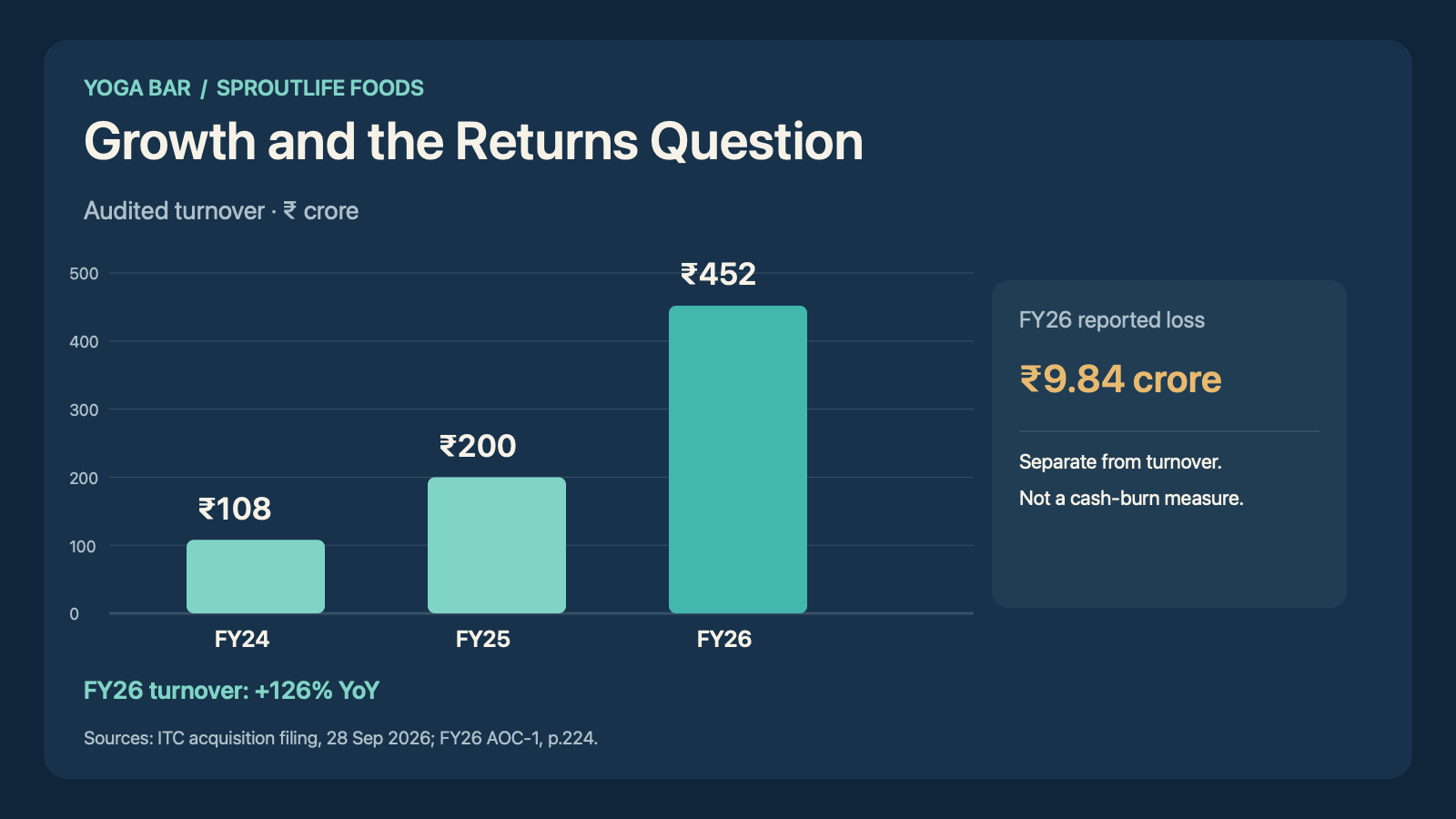
The growth deserves attention. But this evidence cannot identify repeat purchasing, customer-acquisition cost, channel contribution margins or free cash after working capital and investment. A loss during expansion does not by itself establish a bad acquisition. Equally, fast expansion does not establish that each extra sale earns an adequate return.
An illustrative owner’s return test
ILLUSTRATION, NOT A FORECAST: Suppose an investor wanted a 10% annual cash yield on the final ₹645 crore once the business had reached a mature, no-growth state. The acquired 52.5% would need to provide ₹64.5 crore a year. On a proportionate-ownership basis, the whole business would need approximately ₹123 crore of annual cash available to equity owners.
At unchanged FY2026 turnover, that would be about 27% of sales. At hypothetical turnover of ₹800 crore, it would be about 15%; at ₹1,000 crore, about 12%. These turnover levels and the 10% yield are analytical assumptions, not management guidance or an estimate of Sproutlife’s cost of equity.
The calculation is ₹645 crore × 10% ÷ 52.5%. “Cash available” means after operating costs, cash taxes, working capital, capital expenditure and financing obligations. Accounting profit or EBITDA cannot be substituted without a bridge.
A growing business can justify its price with low near-term distributions and larger later cash flows. This simple test excludes growth, timing, terminal value and further funding, so it cannot prove overpayment. It makes the burden of the investment visible. A proper valuation would model those items explicitly and discount the cash accruing to the purchased stake.
The strategic case and its limits
Management reports that ITC’s distribution network reaches nearly seven million retail outlets, more than 40% served directly. Its FY2026 review also describes Yoga Bar’s expansion across bars, muesli, oats and protein products. These are relevant capabilities and product developments. ITC’s entire outlet network must not be presented as Yoga Bar’s distribution footprint. FY2026 Board report, printed pages 60 and 81
Our inference is that broader distribution, procurement and brand support could improve availability and reduce costs per unit. The countercase is that new channels also require trade margins, promotion and inventory. The test is profitable repeat demand after those costs. Much of the collaboration could already occur under April’s control; September’s larger economic interest should not be credited automatically with every synergy of the whole relationship.
What would change the assessment
We would look for separately identifiable operating profitability, cash conversion and the capital required to sustain growth. Organic sales should be separated from changes in the consolidation boundary. Purchase-accounting adjustments, minority-interest changes and the cash payment should be reconciled to the reported accounts.
Our 18 September ITC research already assumed ₹3,528 crore of FY2027 acquisition cash. That schedule must be reconciled before incorporating this transaction into a revised valuation. Simply subtracting another ₹645 crore risks counting the payment twice; assuming it was included without checking is equally unsound. This memo does not update that report’s valuation or price bands.
The ownership question is now straightforward: ITC receives all the future upside and bears all the future downside of Sproutlife. The investment question remains open. Our focus is the cash earned on capital committed, supported by evidence of durable customer demand and disciplined reinvestment. See our research methodology for the distinction between reported facts, calculations and analyst judgement.
Disclosure and risk
As of 4 October 2026, the author holds ITC equity shares as a long-term investment and may hold ITC derivative positions. Relatives may also hold ITC securities. These financial interests may create a conflict of interest. The analyst confirmed that the ownership of the analyst, associates and relatives remained below 1% as of 30 September 2026, and that the other conflict disclosures in the 18 September ITC report remain unchanged.
This memo is general research. The return test is illustrative, not a forecast, recommendation or price target. Investing in securities involves market risk; readers should assess the source filings, assumptions and their own circumstances. AI assisted with drafting and calculations; the research analyst remains responsible for the final analysis.
Regulatory information
This page provides general information about Company Anatomy and the disclosure principles applied to its research. Every dated research report must also be read with its own disclosures, assumptions, risks and source notes.
Research Analyst information
| Name | Aditya Siddharth Mehta |
|---|---|
| Capacity | SEBI-registered Research Analyst — individual registration |
| SEBI registration number | INH000029768 |
| SEBI validity from | 20 August 2026 — Perpetual |
| BSE enlistment number | 7462 |
| Business name | Company Anatomy |
| Telephone | +91 7021135925 |
| Email and grievance contact | adi2001me@gmail.com |
| Correspondence address | Aditya Villa, Daksha Niwas, S.T. Road, Chembur, Mumbai, Maharashtra 400071 |
Business activities and service scope
Company Anatomy publishes independent equity research and educational material concerning Indian listed companies. Research may include business analysis, financial estimates, valuation work, risks and analyst judgement. The website does not provide portfolio management, trade execution, custody, banking, legal, tax or personalised financial-planning services.
Independent and completely free public research
All Company Anatomy research and reports are independent and completely free to read and download. There is no subscription charge, purchase condition or obligation to open a brokerage account or trade. Free public access is a core value of Company Anatomy. Research opinions are intended to reflect analysis and evidence rather than a reader’s transactions.
Merely reading or downloading publicly available research does not by itself create a personalised investment-advisory engagement or an agreement for a separately arranged service. It does not waive investor protections or remove applicable Research Analyst obligations. Whether a particular relationship constitutes a client relationship depends on the actual arrangements and applicable law, including direct or indirect economic benefits; it cannot be settled by calling a report “free”.
Reports are not an offer, invitation or solicitation to buy or sell any security or to enter into a transaction. Where a report contains a recommendation, rating or target price, it remains research subject to applicable requirements; it is not personalised investment advice. Do not use a report as the sole basis for an investment decision.
General nature of research
Research and recommendations are general and are not tailored to an individual reader’s objectives, financial situation, risk tolerance or needs. General website information is not a personalised investment recommendation or a solicitation of an offer to buy or sell a security. This distinction does not exclude the Research Analyst’s applicable regulatory duties. Investors should make an independent assessment and obtain professional advice appropriate to their circumstances.
Sources, estimates and changes
Information is obtained from sources believed to be reliable, with preference for company filings, exchange disclosures and other primary material. Accuracy, adequacy and completeness are not guaranteed. Information may be incomplete or condensed. Forecasts, valuations, target prices and scenarios are estimates rather than facts. Opinions and estimates are the Research Analyst’s judgement as of the stated date and may change without notice.
Ownership, financial interests and material conflicts
Each research report or public recommendation must state, as applicable, whether the Research Analyst, associates or relatives have a financial interest in the subject company; actual or beneficial ownership of one per cent or more of its securities at the end of the month immediately preceding publication; or another material conflict of interest. Aditya Siddharth Mehta has confirmed that there is no business conflict of interest as of 17 September 2026. This business-conflict declaration is not a declaration that the analyst, associates or relatives have no security holdings or issuer relationships. Because holdings and circumstances can change, this general page does not make a permanent “no conflict” representation. The dated report-specific disclosure governs.
Compensation and other relationships
Each research report must disclose applicable compensation received from the subject company during the preceding twelve months, including compensation for investment-banking, merchant-banking, brokerage or other products and services; compensation or benefits connected with the research; whether the subject company was a client during the applicable period; and participation in managing or co-managing a public offering. No blanket statement is made on this page because the disclosure must be current for the subject company and report date.
Other report-specific declarations
- Whether the Research Analyst serves as an officer, director or employee of the subject company.
- Whether the Research Analyst has engaged in market-making activity in the subject company’s securities.
- Relevant associates, business relationships and any fact that could affect independence or objectivity.
- The valuation method and material risks that may prevent achievement of a stated target price.
- Any material disciplinary history, regulatory action, litigation, inspection or investigation required to be disclosed.
If a required report-specific declaration is absent or unclear, do not rely on the recommendation until clarification is obtained from the Research Analyst.
Use of artificial intelligence
Company Anatomy uses artificial intelligence to improve readability and writing, assist valuation calculations and run simulations. The extent and material role of AI in a particular report should be read with that report’s methods and source notes. The Research Analyst remains responsible for the research, human review, accuracy controls, security, confidentiality, integrity and regulatory compliance, regardless of the extent of AI use. AI can produce incorrect text, calculations or assumptions. Readers should cross-check material figures against original filings and source documents, examine assumptions and periodically consult a SEBI-registered investment adviser about their own financial circumstances. These precautions do not transfer the analyst’s regulatory responsibilities to the reader.
Valuation, forecasts and simulation limitations
Valuation models and simulations are conditional analytical tools. Outputs depend on input quality, assumptions, correlations, distributions and model design; they can omit risks and produce materially different results when assumptions change. A simulated frequency is not an observed probability of future investment success. Model values and target prices are not guarantees, promises of returns or precise forecasts. Review the valuation date, horizon, scenarios, sensitivity analysis and downside risks. Historical or simulated performance does not establish future performance.
Market risk and performance
Investment in securities market are subject to market risks. Read all the related documents carefully before investing.
Past performance is not an indicator of future performance. Prices and returns may be volatile, and an investor may lose part or all of the capital invested. Registration granted by SEBI, enlistment with BSE and certification from NISM in no way guarantee performance of the intermediary or provide any assurance of returns to investors.
Distribution, report versions and corrections
Research is intended for lawful access and use. It is not directed to a person or jurisdiction where distribution or use would breach applicable law or require a registration that the Research Analyst does not hold. Free access is not a representation of authorisation outside India. When sharing a report link, retain its date, author, qualifications and disclosures; do not present extracts or simulations as guaranteed returns. A downloaded copy reflects its stated publication date. Check the original report page for subsequent revisions and contact the Research Analyst about a suspected error.
Website, third-party links and liability
The website and its content are provided for information on an “as is” and “as available” basis. Links to third-party websites are provided for convenience and do not constitute endorsement. To the extent permitted by applicable law, Company Anatomy is not responsible for decisions made solely in reliance on general website content or for loss arising from third-party content, interruptions or technical errors. Nothing on this page excludes duties or liability that cannot lawfully be excluded.
Grievances and dispute resolution
First raise a concern directly with Company Anatomy using adi2001me@gmail.com. If the response is unsatisfactory, use SEBI SCORES. Eligible unresolved disputes may be taken to SMART ODR in accordance with the applicable process. See the Grievance Redressal, Investor Charter and Investor Complaints pages.
Regulatory sources
- SEBI Master Circular for Research Analysts, 6 February 2026
- SEBI Investor Charter for Research Analysts, 2 June 2025
Last reviewed: 17 September 2026. This page should be updated when the applicable regulatory framework or the Research Analyst’s material circumstances change.